
Foundations
Creditor operations connect marketplaces, merchants, and creditors to receivables schedules, settlement, and receivables advancement. Before you plan and configure them, complete the prerequisites.
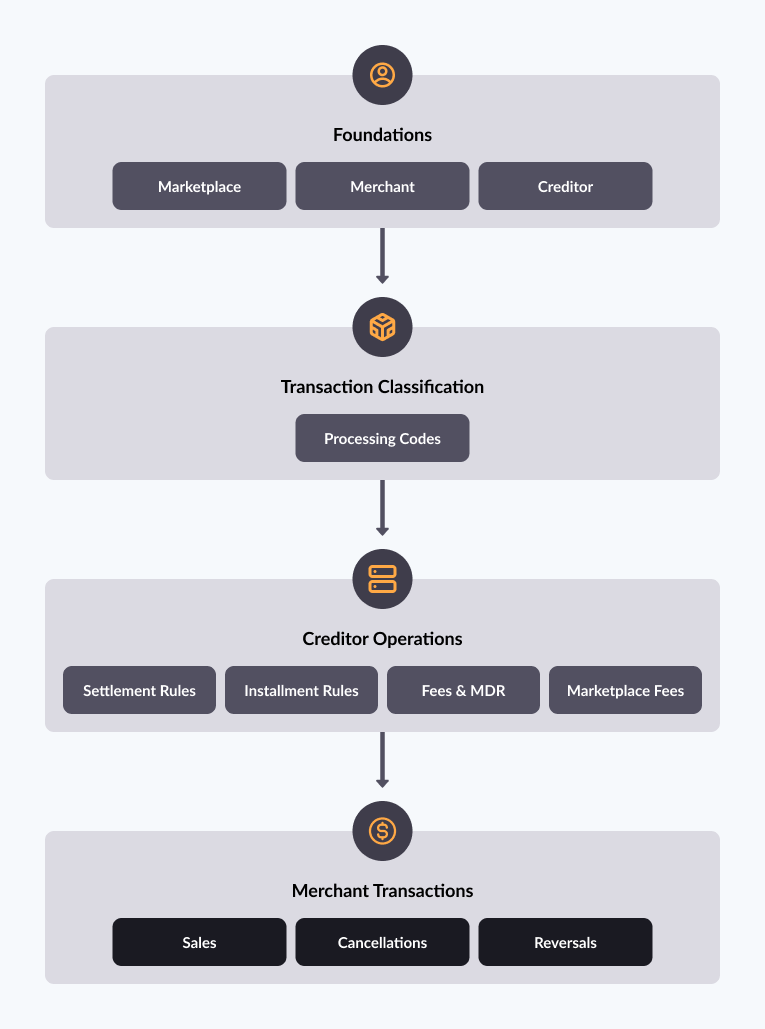
Figure 1: Creditor operations hierarchy
Seller management entities and relationships
| Entity | Role |
|---|---|
| You | Defines business requirements, transaction classifications, and integration behavior. |
| Marketplace | Groups merchants participating in the Seller management structure. |
| Merchant | Represents the seller that generates merchant transaction activity. |
| Creditor | Represents the party associated with the account that receives settlement funds. Also holds the advancement terms that apply to the merchant's receivables. |
| Creditor operation | Defines payment timing, installment treatment, MDR, fee, and settlement conditions. |
Marketplace, merchant, and creditor relationships establish the business context for a transaction. Processing codes identify the transaction classification, and the creditor operation defines the financial conditions Seller management applies to that transaction. After evaluation, receivables schedules provide the resulting payment dates, charges, and scheduled amounts.
Balance direction, processing codes, and transaction classifications
Balance direction must be determined before a transaction enters Seller management. Creditor operations do not define whether a transaction debits or credits an account.
Seller management requires processing codes to classify transactions for this reason. Processing codes act as the bridge between incoming transactions and creditor operation rules used to process them.
A processing code may represent:
- A payment type
- A debit or credit transaction
- An installment type (for example, single-payment or installment purchases)
- Another transaction classification you define
Each creditor operation requires a processing code, but a processing code can exist without being linked to a creditor operation. Two transactions with the same amount can be processed differently if they use different processing codes, resulting in different settlement schedules or fees. When you define processing codes:
- Use separate processing codes for transactions that differ in payment method, settlement timing, MDR, fees, or expected schedule behavior.
- Use one processing code for the different installment counts of the same scenario. Each installment count has its own creditor operation under that code. Refer to Installments for more information.
- Reuse an existing processing code when transactions have the same business meaning and are intended to produce the same creditor operation outcome.
For more information on processing-code concepts, refer to Processing codes and transaction types.
You must configure the processing codes that define debit or credit behavior before you can submit merchant transactions or any creditor operation-related activities to Seller management.
Updated 1 day ago