
Statement agreements
If a cardholder wishes to renegotiate all debt—past, present, and future—use a statement agreement contract.
If you don’t advance all future debt to the current statement before implementing the statement agreement, the compensation between the statement agreement credit and the future debt will only happen in the future closing dates.
The platform then:
- Adds a credit to the total balance for current statements after advancing all future debt.
- Creates installments for current and future statements
Refer to the figure below.
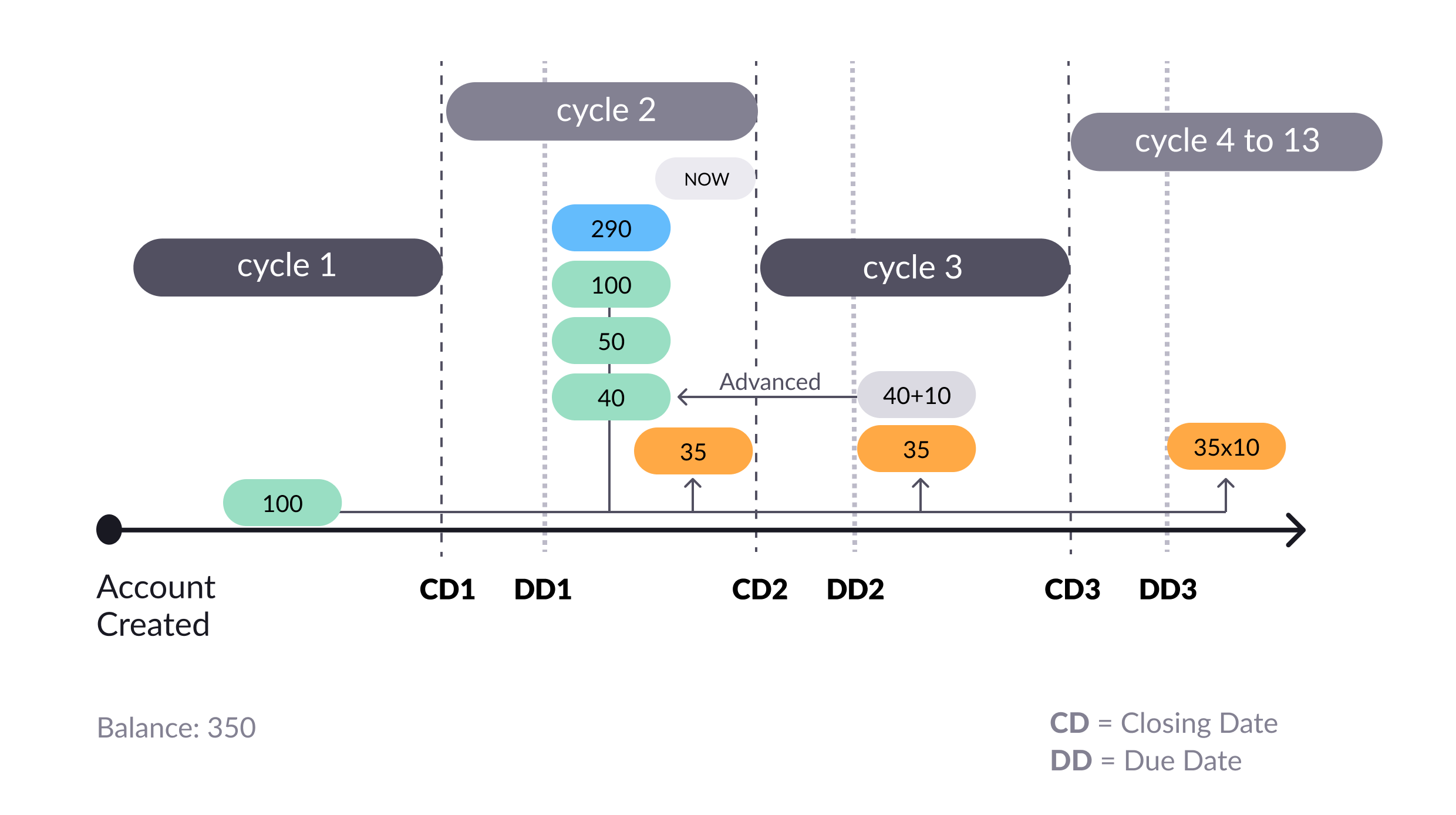
Advancing future debt to the current cycle and creating installments (shown in gray and orange)
After implementing the statement agreement in Cycle 2, the total balance is 290 for 12 installments. To avoid becoming overdue again, the cardholder has to make a payment of 35 for the next 12 due dates.
A note for Brazilian developersAccording to a Brazilian Central Bank resolution, any debt renegotiation occurring after 1 January, 2024 may not have a sum of interest and fines higher than the original debt amount. This includes revolving interest charges and payment agreement interest.
Creating a statement agreement
Before you create a new statement agreement, make sure the customer is eligible for refinancing. So, check with your organization’s refinancing terms, procedures, and conditions (for example, debt-to-income or credit history).
If the customer is eligible for refinancing:
- Get the balance information for the account using the Get total amount due endpoint.
- Get the refinanced amount from the
balance.openfield in the response. - Use your own calculation method based on the refinanced amount to generate a new payment plan.
Since the Pismo platform supports a collection of installments, you can use any desired amortization system to calculate a payment agreement.
- Use the Create installment advance without interest endpoint to advance all installments on the account to the current statement.
- After you have the plan, use the Create payment agreement endpoint to create a new statement agreement, setting the values of the body parameters as indicated in Steps 6 through 8.
- Set the values of the following parameters as indicated.
statement_agreement=truecompulsory=falsesettle_accrual=false
- Use the
installmentbody parameter to create an array of installments for the payment agreement. - Populate the remaining fields. Note that IOF fields only apply to Brazil. If you’re not in Brazil, enter 0 in the IOF fields.
- Execute the endpoint.
Once you’ve created a new statements agreement, the Pismo platform posts the new agreement on the currently open and future statements. If the customer needs to cancel the agreement, use Cancel payment agreement.
Manage existing statement agreements
Use the other endpoints in the Refinancing API to search for and manage your statement agreements (as well as other types of payment agreements).
Updated 7 months ago